
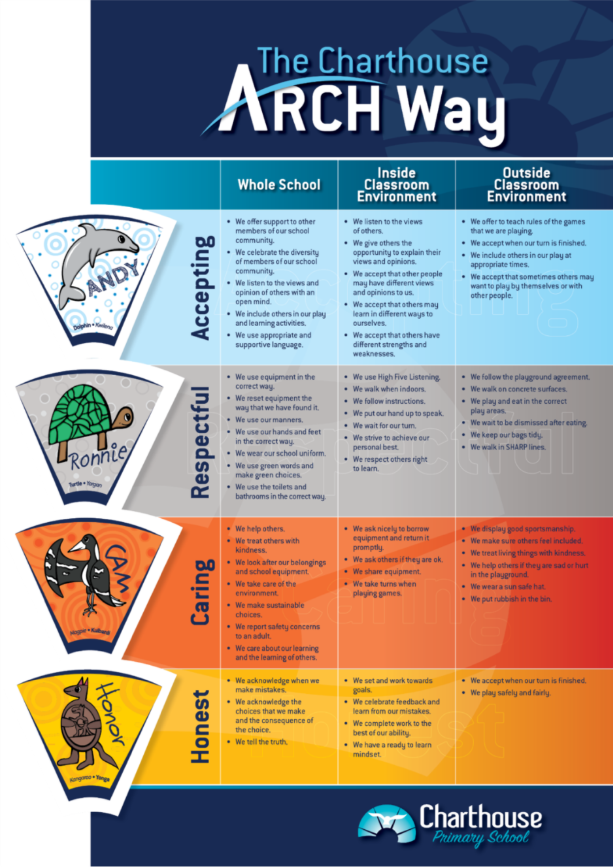
Charthouse Primary School is a Positive Behaviour Support (PBS) school. We have four ARCH Values that underpin out whole-school Expectations.
PBS is a whole-school framework designed to create positive learning environments by teaching and reinforcing expected behaviours. It’s a proactive, evidence-based approach that involves setting clear expectations, explicitly teaching appropriate behaviour, celebrating good behaviour, and providing support to improve academic and behavioural outcomes for all students.
“PBS combines behavioural, cognitive, biophysical, social, developmental, and environmental psychology. PBS is focused on the design of environments that promote desired behaviours and minimize the development and support of problem behaviours.”
– Dunlap, G., Sailor, W., Horner, R.H., Sugai, G. (2009). Overview and History of Positive Behaviour Support. In: Sailor, W., Dunlap, G., Sugai, G., Horner, R. (eds) Handbook of Positive Behaviour Support. Issues in Clinical Child Psychology. Springer, Boston, MA. https://doi.org/10.1007/978-0-387-09632-2_1
Our ARCH Expectations are reviewed regularly, and a weekly focus is set for the whole school.
PBS Team Leaders

Junior School: K – Year 2
Sam Hartill-Wilson
samantha.Hartill-Wilson@education.wa.edu.au

Senior School: Year 3 – 6
Karen Coetzer karen.coetzer@education.wa.edu.au
Whole School Routines

Minor and Major Behaviours
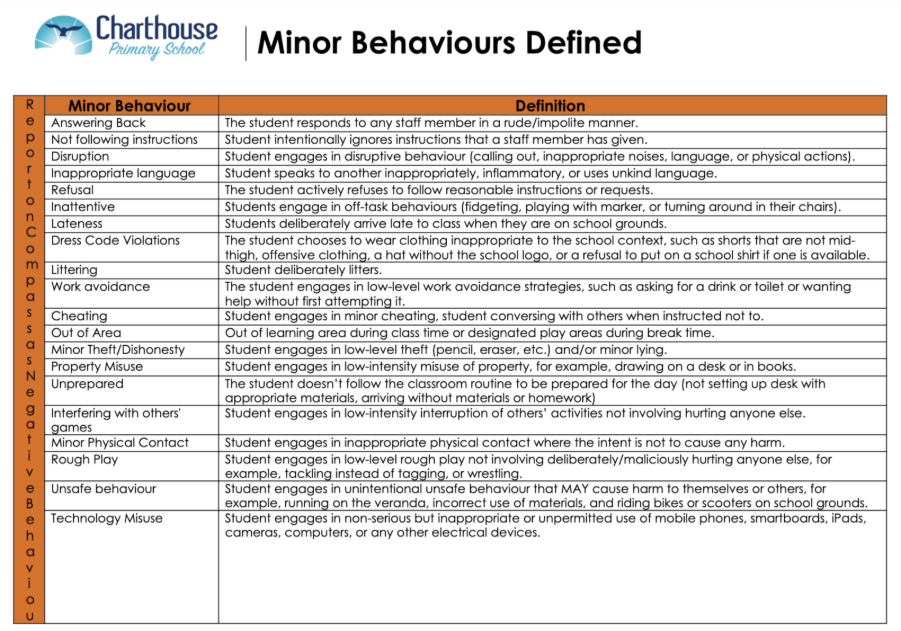
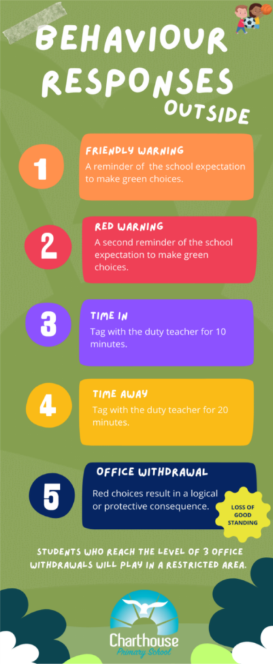
For Minor Behaviours, staff follow the Behaviour Response Grid displayed in every classroom.
Students who receive a ‘Time In’ for three consecutive days, enter the Warning Zone. Administration and Parents/Carers are informed. Administration supports with this process.

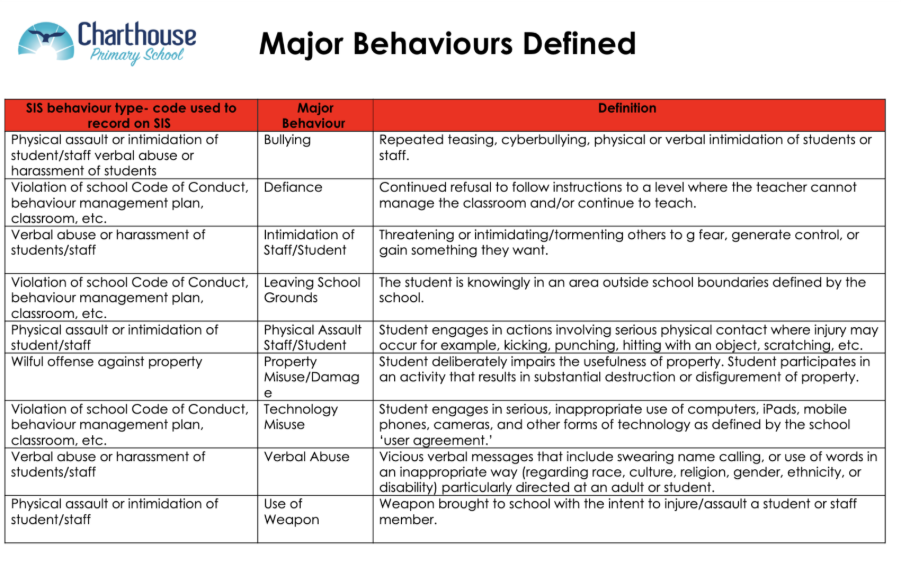
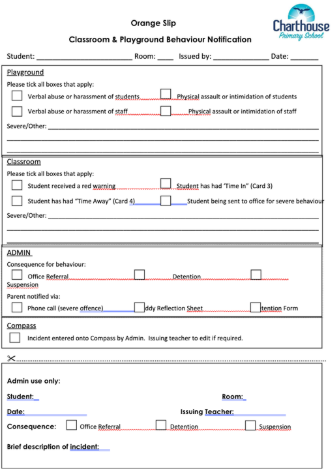
A Major Behaviour Slip (orange) is sent with the student to the office for Major Behaviours. After a thorough investigation, the student may lose their Good Standing, as per the Behaviour and Well-Behaviour Policy. Further consequences may be provided, and Administration will contact home.
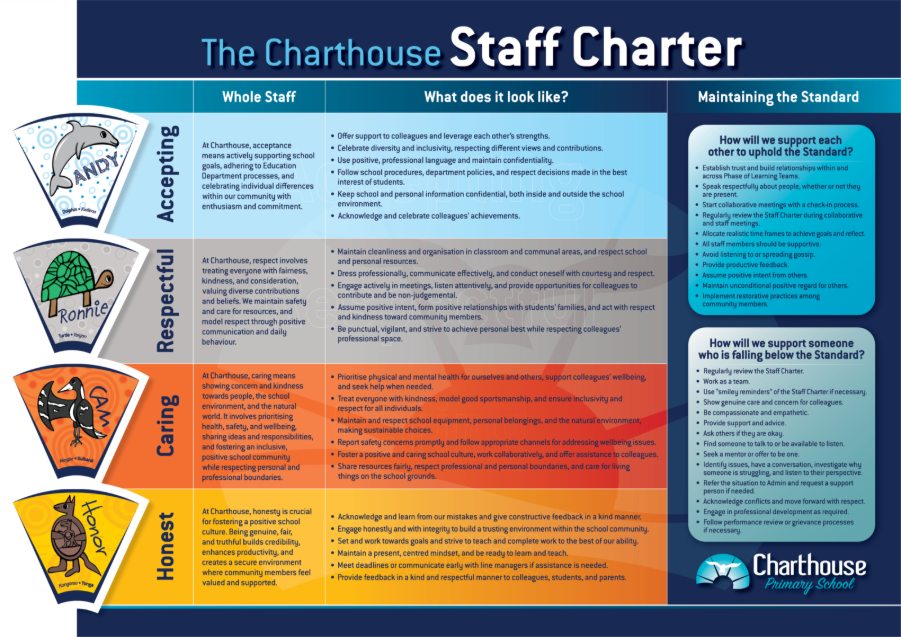
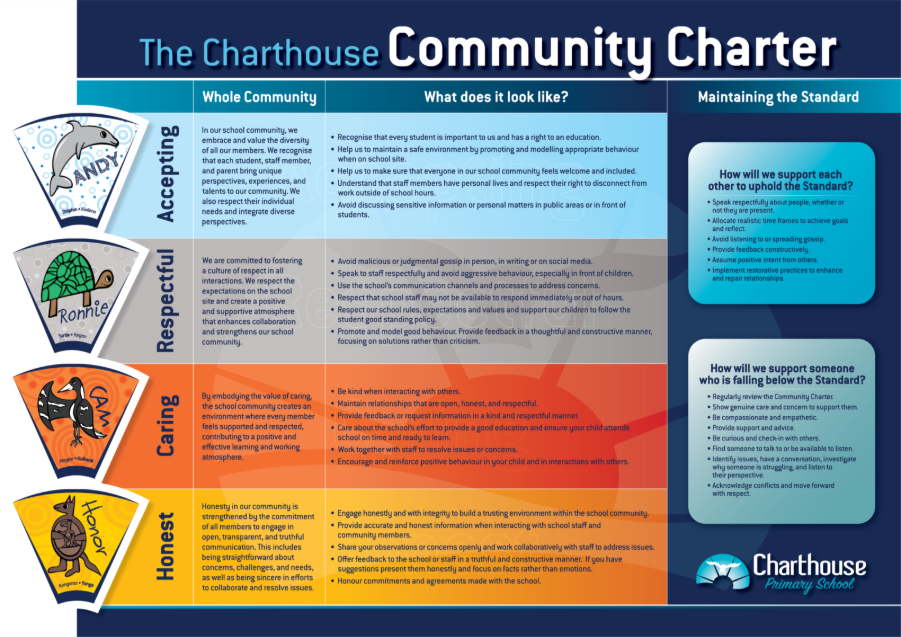
Whole-school PBS Framework – ARCH.
For Students:
For Staff:
For the Community:
Tokens – Positive Reinforcement
Students receive tokens for displaying ARCH Values – Accepting, Respectful, Caring or Honest. Staff aim to hand out five tokens per student per day.
The ARCH Token Shop is open in weeks 5 and 10 for students to spend tokens.
Classroom Management Skills (CMS)
Staff at Charthouse use low key responses to prevent behaviour escalations. These responses include:
- Winning over – greet students at the door, use students’ names, predictable routines, Welcome Circle.
- Proximity control – walk around the classroom while students are working, move closer to students who are off-task and use subtle non-verbal cues, such as eye contact.
- Deal with the problem, not the student – remove distractions.
- Private dialogue – call student to the side, rather than addressing a problem in front of the whole class.
- Effective transitions – use of whole-school transitioning routines.
- Non-verbal cues – eye contact, gestures, hand up to signal stop, or head shake.
- Planned ignore where suitable.
Whole-school attention grabbers are used, and 100% compliance is expected from students. Some popular attention grabbers are:
- Teacher: 3-2-1 waterfall. Students: Shhhh…
- Teacher: Hands on top. Students: That means stop (with hands on head).
- Teacher: Hocus Pocus. Students: Everyone focus.
- Teacher: Stop, Look and Listen. Students: Stop, Look and Listen.
- Teacher: 1 2 3 Eyes on me. Students: 1 2 Eyes on you.
Berry Street Education Model (BSEM)
BSEM is a trauma informed, evidence-based practice with student-centred strategies to provide staff with practical skills to build a safer classroom where learning and well-being are prioritised as essential for growth and achievement.
It is a practical approach to empower students to meet their needs for belonging, relational connection, and safety for learning.
At Charthouse, we believe unconditional positive regard is important for building trust between staff and students.
“Unconditional positive regard is feeling warm and positive towards others, independent of their actions or behaviour” (Rogers, 1961).
Visit the Berry Street website for more information:
The following BSEM strategies have been successfully implemented at Charthouse to ensure students feel safe and have a sense of belonging:
BSEM strategies
- Ready-to-learn scale
- Morning Circles with positive primers
- Calming Corners in each classroom to encourage self-regulation
- Positive Relationships with students
- Chill Zone every morning until 9:05, students need a pass
- Therapy Dogs – students need a pass from teacher
- Engagement Norms – displayed in classrooms
- Predictable environments
- Brain Breaks – 2 minutes between lessons
- Mindfulness every day after lunch
- Engagement officer – a referral form needs to be completed
Staff Well-being
- Mrs Brown’s Coffee Van
- R U OK Day
- End of year functions
- Thai on Tyres Food Van
- Staff Charter
- Secret Friend
- Staff Check-Ins
- Shout-Outs
- Morning Teas
- Yoga
- Walking Club
- Prioritising work-load